


On September 29, 2026, the World Intellectual Property Organization (WIPO) published the Global Innovation Index 2026 (GII 2026), the 19th edition of the report. The GII 2026 assesses the innovation performance of 139 economies worldwide and also identifies the world’s top 100 innovation clusters.
The theme of the GII 2026 is “Powering Entrepreneurs at the Frontier of Science,” focusing on science-based startups and their ability to turn advanced scientific research into products, businesses, and new industries. The report places particular emphasis on research-intensive fields such as health technologies, quantum computing, agricultural technology, semiconductors, and biotechnology.
Viet Nam ranks 43rd among 139 economies
In the 2026 ranking, Viet Nam ranks 43rd out of 139 economies. Viet Nam also ranks second among lower-middle-income economies, behind India and ahead of the Philippines. Within South East Asia, East Asia, and Oceania, Viet Nam ranks ninth among 17 economies.
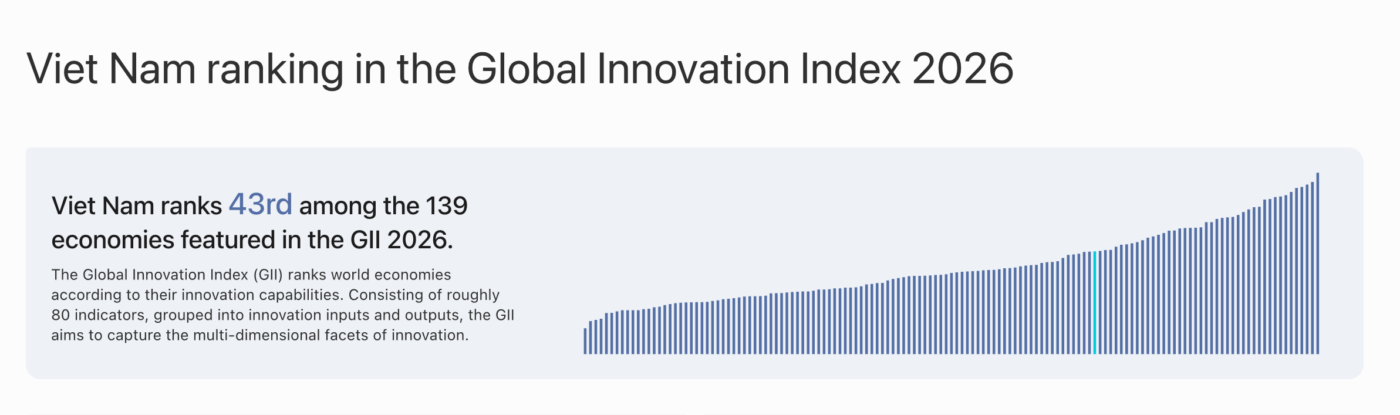
Hình: Việt Nam xếp thứ 43 trong tổng số 139 nền kinh tế được đánh giá trong GII 2026. Nguồn: WIPO, Global Innovation Index 2026.
Viet Nam’s position among lower-middle-income economies is also reflected in WIPO’s ranking of the top innovation economies by income group. Viet Nam ranks second in the lower-middle-income group, following India and ahead of the Philippines.
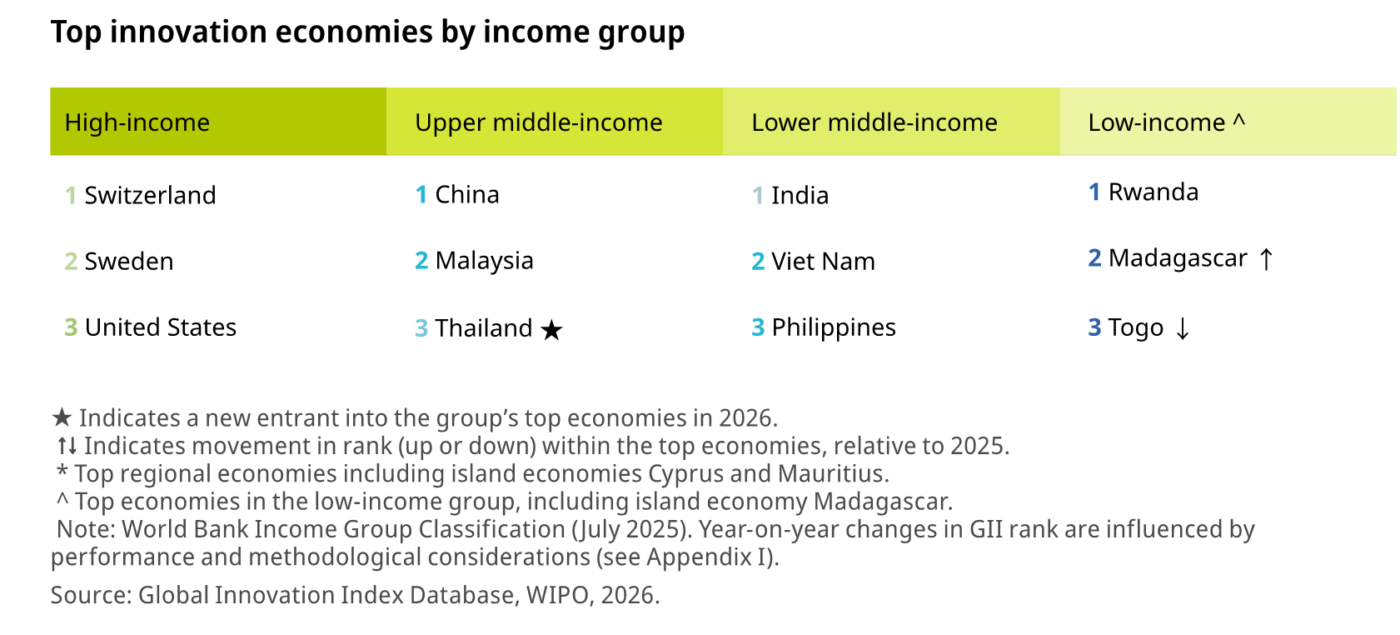
Figure: Top innovation economies by income group in the GII 2026. Viet Nam ranks second among lower-middle-income economies. Source: Global Innovation Index Database, WIPO, 2026.
Viet Nam continues to perform above expectations for its level of development
Notably, WIPO continues to identify Viet Nam as one of the economies whose innovation performance is above expectations for its level of economic development. Together with India, Viet Nam has maintained this performance for 16 consecutive years.
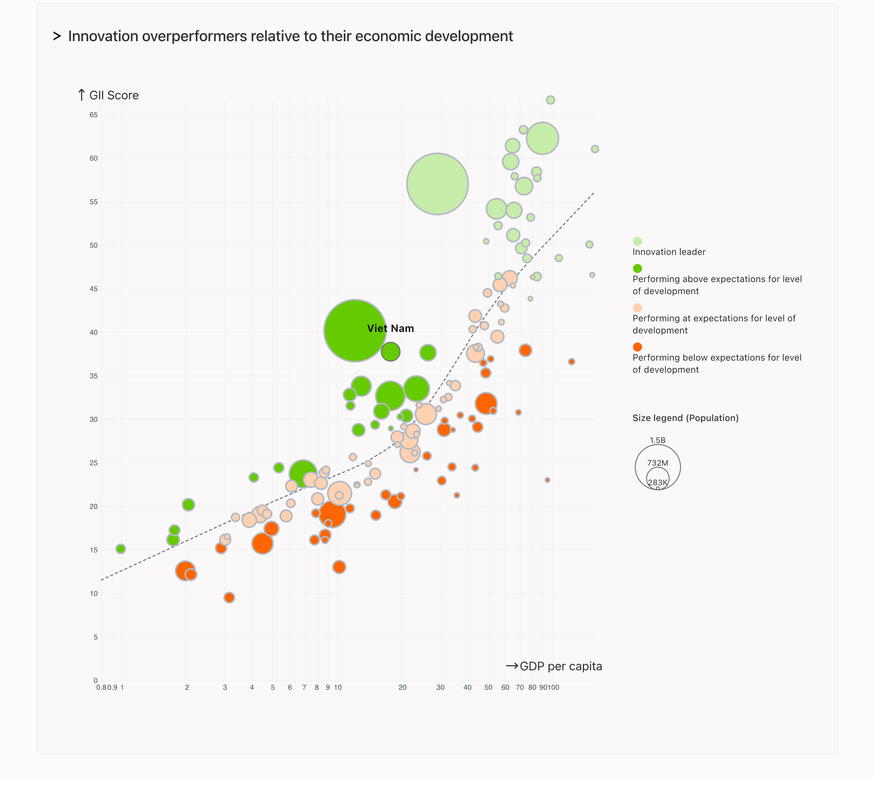
Figure: Viet Nam ranks 43rd among the 139 economies covered by the GII 2026. Source: WIPO, Global Innovation Index 2026.
Viet Nam ranks 43rd, with innovation outputs outperforming inputs
One of the notable findings of the GII 2026 is the difference between Viet Nam’s rankings for innovation inputs and innovation outputs.
According to WIPO, Viet Nam ranks 54th in innovation inputs but 35th in innovation outputs. This indicates that Viet Nam is generating innovation results at a level higher than might be expected from its available innovation resources. WIPO places Viet Nam among the economies that are relatively effective in converting innovation resources into tangible results.
A similar pattern can be seen in several other middle-income economies, including China, India, Türkiye, the Philippines, and Morocco. For Viet Nam, this performance is associated with its deep integration into global value chains, the development of high-tech manufacturing, international trade, and the emergence of industries capable of producing increasingly technology-intensive goods and services.
At the same time, WIPO notes that middle-income economies continue to face significant gaps in areas that require longer-term development, particularly research capacity, R&D, academic infrastructure, scientific output, and links between research institutions and businesses.
High-tech manufacturing and exports remain key strengths for Viet Nam
WIPO notes that Viet Nam and the Philippines have made significant progress through their integration into international production and service networks. For Viet Nam, this strength is particularly evident in high-tech manufacturing and trade.
According to the GII 2026, Viet Nam performs at levels comparable to high-income economies in certain indicators related to high-tech manufacturing and high-tech exports. Viet Nam also ranks third globally in high-tech imports. In addition, the country performs strongly in several areas of the digital and creative economy, including a fifth-place ranking globally in mobile app creation.
These results reflect Viet Nam’s growing role in global high-tech production and trade networks. However, WIPO also notes that Viet Nam’s capacity for high-tech production and exports has developed faster than its domestic capacity to generate knowledge and technology.
The report indicates that Viet Nam and the Philippines remain below the median of middle-income economies in certain indicators related to scientific publications and PCT patent filings. WIPO therefore considers the next stage of development for these economies to depend significantly on expanding domestic research, increasing patenting activity, and strengthening their capacity to generate knowledge.
Intellectual property is becoming increasingly closely linked to technology commercialization
One aspect of particular relevance to businesses and the intellectual property sector is the role of IP assets in the development of deep science companies.
In the GII 2026, WIPO introduces the Dealroom–WIPO Deep Science Startup Tracker, a new system tracking deep science startups and university or public research spinouts built around scientific and engineering breakthroughs.
According to WIPO’s data, approximately 50% of deep science startups own patents, compared with only 15.4% of other startups. Patent ownership also tends to increase as startups move through later stages of development, reaching approximately 69% at the late stage.
WIPO notes that for deep science companies, patents can play an important role in attracting investment, facilitating technology partnerships, supporting licensing, and expanding commercialization. Because deep science technologies often require many years to progress from initial research to commercial products, intellectual property can become an important asset throughout a company’s development.
From this perspective, IP is not merely a legal tool for preventing infringement. It can also form an integral part of a company’s business strategy and technology commercialization process.
GII 2026 highlights the gap between research and commercialization
A recurring theme throughout the GII 2026 is the gap between generating research results and successfully bringing those results to market.
WIPO notes that deep science companies often face difficulties at critical transition points: from research to proof of concept, from testing to commercial deployment, and from a functioning technology to a scalable business capable of generating revenue. Factors such as limited funding at certain stages, shortages of specialized talent, regulatory barriers, and uncertain market demand can slow this process.
Against this backdrop, WIPO highlights the need for a more comprehensive support ecosystem, including technology transfer mechanisms, shared laboratories and testing facilities, certification pathways, funding for different stages of development, and an appropriate intellectual property system.
The report also discusses tools such as patent pools and IP-backed finance, illustrating how intellectual property is increasingly viewed not only from a legal perspective but also as a financial and commercial asset.
Viet Nam in the regional innovation landscape
South East Asia, East Asia, and Oceania remain among the world’s dynamic innovation regions. The Republic of Korea ranks fourth globally, Singapore fifth, China tenth, Japan twelfth, and Hong Kong (China) fourteenth.
Among middle-income economies, Malaysia ranks 34th, Viet Nam 43rd, Thailand 44th, the Philippines 52nd, and Indonesia 55th.
WIPO notes that the region has a high degree of integration into regional and global value chains, with strengths concentrated in high-tech trade, high-tech manufacturing, ICT services, and entrepreneurship. Viet Nam is one of the economies where this development model is particularly evident through high-tech manufacturing and trade.
The world’s leading innovation economies in 2026
At the top of the ranking, Switzerland remains the world’s leading innovation economy in the GII 2026, marking its 16th consecutive year at the top. Sweden ranks second and the United States third. The Republic of Korea and Singapore rank fourth and fifth, respectively.
The United Kingdom ranks sixth, followed by the Netherlands in seventh, Finland in eighth, Denmark in ninth, and China in tenth. China remains the only middle-income economy among the world’s top 10 innovation economies.
The report also shows considerable stability among the leading economies. No new economy entered the top 15 in 2026, while Europe continued to account for a large share of the leading economies, with 14 economies among the top 25.
The world’s leading innovation clusters
In addition to ranking economies, the GII 2026 identifies the top 100 innovation clusters worldwide, based on the concentration of scientific, technological, and creative activity.
Shenzhen–Hong Kong–Guangzhou remains the world’s leading innovation cluster in 2026, followed by Tokyo–Yokohama, San Jose–San Francisco, Beijing, and Seoul.
The five leading clusters retained their positions from the previous year, demonstrating the continued stability of the world’s major innovation centers. China and the United States also remain the two countries with the largest numbers of innovation clusters among the global top 100.
Outlook for innovation and intellectual property in Viet Nam
The GII 2026 places Viet Nam in a notable position within the global innovation ecosystem. Ranking 43rd among 139 economies and continuing to be recognized by WIPO as an economy performing above expectations for its level of development over 16 consecutive years reflects significant progress in Viet Nam’s innovation capabilities.
At the same time, the gap between innovation inputs and outputs highlights an important characteristic of Viet Nam’s innovation ecosystem: its relatively strong ability to generate results from the resources currently available. Further progress, however, will depend not only on expanding high-tech manufacturing or exports, but also on strengthening domestic research and business R&D, increasing domestic knowledge creation, and building stronger connections between universities, research institutions, businesses, and markets.
For technology companies and startups in Viet Nam, the trends identified by WIPO also underline the growing importance of developing an IP strategy from the early stages of research and development. Identifying potentially protectable technologies, selecting appropriate forms of protection, determining the markets where protection is needed, and building a strategic IP portfolio can form part of a company’s commercialization and growth strategy rather than being treated as a step only after a product has been completed.
The GII 2026 therefore not only reflects Viet Nam’s position in the global innovation landscape but also highlights an important issue for the next stage of development: how Viet Nam can translate its strengths in high-tech manufacturing and trade into stronger domestic capabilities in technology creation, knowledge generation, and the development of high-value intellectual property.
Source: World Intellectual Property Organization (WIPO), Global Innovation Index 2026 – Powering Entrepreneurs at the Frontier of Science.





Need Legal Advice on Intellectual Property?
Our experienced IP lawyers provide comprehensive services: patent and trademark registration, industrial design, copyright, dispute resolution...
Get Free Consultation