


2026 marks a turning point in how Vietnam approaches intellectual property. Rather than handling isolated cases, the authorities have shifted toward coordinated, decisive, and systematic action nationwide. For businesses, this represents both a warning about legal risk and an opportunity to proactively protect their intellectual assets. Accordingly, this article analyzes the most significant policy developments and offers practical recommendations for enterprises.
Pressure From Home and Abroad
The momentum behind this crackdown comes from both directions. On the international front, on 30 April 2026 the Office of the United States Trade Representative (USTR) released its Special 301 Report 2026, in which Vietnam was placed on the “Priority Foreign Country” list, the highest level of warning under this mechanism [1]. As a result, this signals that major trading partners now hold higher expectations for Vietnam’s intellectual property enforcement capacity, with potential consequences for the investment and export environment. In response, Vietnam has demonstrated strong political will while also requesting that the United States provide an objective and balanced assessment of Vietnam’s efforts and results [2].
Domestically, although enforcement efforts in recent years have shown positive progress, infringement nevertheless remains complex, particularly in the digital environment. For this reason, the Government has determined that unchecked intellectual property infringement directly harms the investment and business climate as well as the legitimate rights and interests of citizens and honest enterprises [3].

A Series of Legal Instruments Activated
The rapid succession of directives issued in the first half of 2026 reflects clear political resolve. To begin with, Directive No. 02/CT-TTg dated 30 January 2026 of the Prime Minister on strengthening intellectual property enforcement focused on the program to combat counterfeit and imitation goods and to protect consumers in the e-commerce environment [2].
Subsequently, Official Dispatch No. 38/CD-TTg dated 5 May 2026 launched a nationwide peak enforcement campaign from 7 to 30 May 2026, guided by the principle of “no exceptions, no off-limits areas” [3][4]. In particular, the campaign targeted key areas such as copyright infringement of films, music, and video games, along with infringement of trademarks and geographical indications, as well as the production of counterfeit branded goods [4].
Of particular note for businesses in the creative and entertainment sectors, Decree 134/2026/ND-CP clarified the boundary between using music for personal purposes and commercial exploitation, while also requiring businesses to change their awareness of copyright in the digital economy [5]. Consequently, this change compels businesses to review their entire use of copyrighted works in operations, from background music at service premises to digital content distributed to the public.
Enforcement Is No Longer on Paper: The Numbers Speak
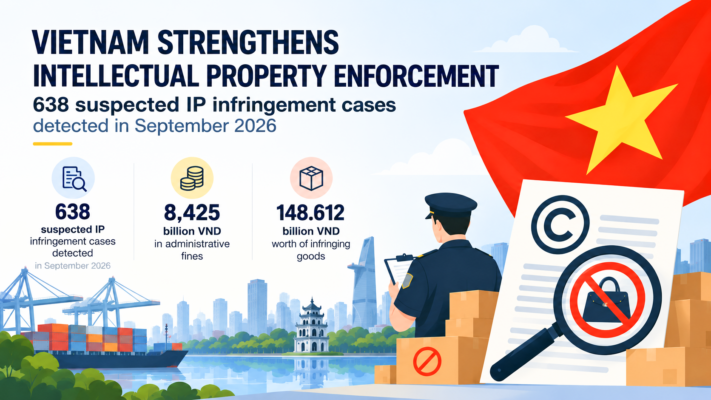
What businesses should pay particular attention to is the level of enforcement in practice. During the peak campaign from 7 to 30 May 2026 alone, the authorities detected approximately 2,036 violation cases, which represented a sharp increase compared to the same period in 2025 [6]. Moreover, as of 27 May 2026, the country had handled 1,438 cases, of which 1,146 were dealt with administratively and 28 were criminally prosecuted, with total administrative fines exceeding VND 12.6 billion and the value of infringing goods reaching around VND 35.7 billion [7]. Notably, the number of cases handled in this period was three times the 2025 monthly average, while the number of criminal prosecutions already reached about 60 percent of the previous full year’s total [7].
The Economic Police force alone (Ministry of Public Security), from 7 May to 19 June 2026, detected and administratively handled 236 cases with total fines of VND 2.3 billion and infringing goods worth VND 12 billion. In addition, it prosecuted 90 cases involving 142 defendants for intellectual property crimes [8]. The trend toward criminalizing serious infringements is therefore a notable development, because previously most cases stopped at administrative handling. In the digital environment, moreover, within a single month 194 websites were blocked, including 8 film-streaming sites, 27 sites selling goods that infringe industrial property rights, and 159 sites illegally live-streaming football [9].
Taken together, this reality sends a clear message. In short, the legal risk arising from intellectual property infringement, including business models that hide behind digital platforms, has become tangible and can lead to criminal liability rather than merely administrative fines [10].
Legal Risks Businesses Need to Identify
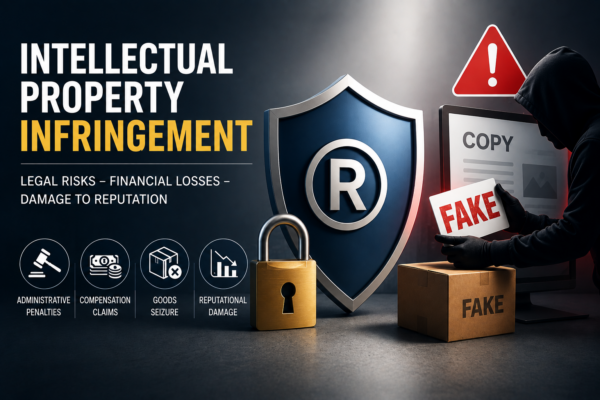
From an advisory perspective, we observe that Vietnamese businesses face risk on several layers. First, there is the risk of becoming an infringer by using images, music, software, trademarks, or digital content without lawful rights, especially given that the commercial boundary has been tightened under the new regulations [5]. Second, there is the risk of being infringed, whereby a business’s own intellectual assets are copied or counterfeited without adequate registered protection to establish a legal basis for defense.
Furthermore, the severity of enforcement has risen considerably. For infringement of copyright and related rights on a commercial scale, current criminal law permits fines of up to hundreds of millions of dong, non-custodial reform, and even criminal prosecution of individuals and commercial legal entities where illicit gains or damages exceed statutory thresholds [11]. For this reason, distinguishing between civil, administrative, and criminal handling requires careful legal assessment on a case-by-case basis.
Raising Awareness Alongside Enforcement
Alongside tough enforcement measures, raising public awareness has been identified as a sustainable solution. Indeed, the authorities have intensified outreach through many channels, and the Ministry of Public Security in particular has coordinated with the press to broadcast special programs on television in order to raise awareness and responsibility for compliance with intellectual property law [12]. At the local level, meanwhile, Hanoi has launched a digital platform to receive infringement reports, which has attracted hundreds of reports from residents and enabled the prompt handling of numerous cases [7]. This model therefore shows that community participation is becoming a link in the enforcement chain.
Recommendations for Businesses
In this context, businesses should be proactive rather than reactive. First of all, they should conduct a comprehensive review of existing intellectual assets and their registration status, including trademarks, industrial designs, patents, copyright, and related rights. In parallel, businesses should verify the legality of all content, software, images, and music used in operations, especially on websites, applications, and e-commerce channels.
In addition, establishing internal compliance procedures, training staff awareness, and setting up a response mechanism when infringement is detected will help businesses minimize risk and protect their competitive advantage. As emphasized at the Government’s conference, intellectual property is not merely a defensive tool but also a sharp weapon for businesses to capture international markets. However, this is only achievable when businesses have the awareness to protect and upgrade themselves [3].
How We Can Help
With experience in the field of intellectual property, our team of lawyers supports businesses in matters ranging from registering and protecting trademarks, patents, industrial designs, and copyright, through reviewing and assessing compliance risk, to resolving disputes and infringements and representing clients before the authorities. Therefore, in a period of tightened enforcement like the present, a well-structured intellectual property strategy is no longer optional but rather an essential requirement for protecting business value.
If your business needs advice on protecting or handling matters related to intellectual property rights, please contact us for timely support.
References
[1] Nhan Dan Newspaper, “Vietnam resolutely handles all acts of intellectual property infringement” (18 May 2026). https://nhandan.vn/viet-nam-kien-quyet-xu-ly-nghiem-moi-hanh-vi-xam-pham-quyen-so-huu-tri-tue-post963128.html
[2] Vietnam+, “Vietnam strengthens international cooperation, efforts to protect intellectual property rights” (14 May 2026). https://www.vietnamplus.vn/viet-nam-tang-cuong-hop-tac-quoc-te-no-luc-bao-ve-quyen-so-huu-tri-tue-post1110483.vnp
[3] Government Web Portal, “Launching a nationwide campaign to prevent and handle IP infringement from 7–30 May 2026” (4 May 2026). https://baochinhphu.vn/ra-quan-ngan-chan-xu-ly-hanh-vi-xam-pham-quyen-so-huu-tri-tue-tren-toan-quoc-tu-07-5-30-5-2026-102260505215535892.htm
[4] Ministry of Science and Technology Web Portal, “Nationwide campaign to handle IP violations from 7–30 May 2026” (6 May 2026). https://mst.gov.vn/ra-quan-toan-quoc-xu-ly-vi-pham-so-huu-tri-tue-tu-7-30-5-2026-19726050609315155.htm
[5] Pho Bien Phap Luat, “Copyright and IP infringement: Identifying violations in the digital age” (17 May 2026). https://phobienphapluat.vn/xam-pham-ban-quyen-so-huu-tri-tue-nhan-dien-vi-pham-trong-thoi-dai-so-a4932.html
[6] Vietnam+, “Improving the effectiveness of the fight against IP infringement” (2 June 2026). https://www.vietnamplus.vn/nang-cao-hieu-qua-dau-tranh-xam-pham-quyen-so-huu-tri-tue-post1114033.vnp
[7] Phap Luat Vietnam Newspaper, “Cracking down hard on intellectual property infringement” (1 June 2026). https://baophapluat.vn/manh-tay-chong-xam-pham-so-huu-tri-tue.html
[8] Ministry of Public Security Web Portal, “Resolutely fighting, preventing and handling crimes and violations of IP law.” https://bocongan.gov.vn/chinh-sach-phap-luat/bai-viet/quyet-liet-dau-tranh-voi-toi-pham-vi-pham-phap-luat-ve-so-huu-tri-tue-1782188677
[9] Bao Dau Tu, “The Ministry of Public Security has prosecuted 56 cases and 98 defendants for IP infringement.” https://baodautu.vn/bo-cong-an-da-khoi-to-56-vu-va-98-bi-can-xam-pham-quyen-so-huu-tri-tue-d611876.html
[10] Government Web Portal, “A series of copyright infringement cases prosecuted: Ministry of Public Security tightens enforcement in the digital environment” (20 May 2026). https://baochinhphu.vn/hang-loat-vu-an-vi-pham-ban-quyen-bi-khoi-to-bo-cong-an-siet-xu-ly-vi-pham-tren-moi-truong-so-102260520135557899.htm
[11] Suntrust, “Handling intellectual property infringement by criminal measures in 2026” (2 June 2026). https://suntrust.vn/xu-ly-xam-pham-quyen-so-huu-tri-tue-bang-hinh-su/
[12] Government Web Portal, “A series of copyright infringement cases prosecuted: Ministry of Public Security tightens enforcement in the digital environment” (20 May 2026). https://baochinhphu.vn/hang-loat-vu-an-vi-pham-ban-quyen-bi-khoi-to-bo-cong-an-siet-xu-ly-vi-pham-tren-moi-truong-so-102260520135557899.htm




Need Legal Advice on Intellectual Property?
Our experienced IP lawyers provide comprehensive services: patent and trademark registration, industrial design, copyright, dispute resolution...
Get Free Consultation