


I. Background, Requirements, and Legal Framework
Machine translation and large language models (LLM) have significantly shortened the time needed to translate various documents into Vietnamese and other languages. However, a patent application is not an ordinary document. It is at once a technical document and a legal instrument that defines the scope of an exclusive right, and it must strictly comply with the legal requirements governing the form and content of a patent specification.
Because patent laws, drafting conventions, and procedural requirements vary across jurisdictions, AI translation tools often exhibit systematic weaknesses when translating patent applications. These errors do not usually result from ordinary mistranslations. Instead, they arise because AI lacks an understanding of the legal, technical, and procedural requirements specific to each patent system. The following sections examine the most common risks and translation errors encountered when AI is used to translate patent applications for filing in Vietnam.
Three core requirements for a patent translation
Before examining specific errors, it is worth establishing one basic principle: a patent translation only meets the required standard when it satisfies three core requirements at the same time.
Technical requirement
The translation must accurately reflect the technical content of the invention, including specialized terminology, technical features, operating mechanisms, technical parameters, working examples, and consistent terminology throughout the document. Meeting this requirement demands more than language fluency. The translator must correctly understand the technical nature of the invention, be well versed in the relevant field of technology, and have enough subject-matter expertise to accurately interpret the disclosed content.
Legal requirement
The translation must accurately convey the scope of protection of the invention, particularly the claims, consistent with the content of the original application. The translation process must never broaden, narrow, or introduce ambiguity into the scope of protection. This requirement is especially important because every term used in the claims can directly affect how the scope of protection is determined.
Administrative/procedural requirement
The translation must fully satisfy the form and formatting requirements set by national regulations, including document structure, presentation style, mandatory terminology, formatting, and other administrative requirements. This requirement ensures that the application is accepted and processed correctly, independent of the technical and legal accuracy of the translated content.
Although current AI tools can meaningfully assist with translation, terminology standardization, and processing efficiency, they still cannot reliably satisfy all three requirements at once. In particular, ensuring the legal scope of protection and complying with administrative requirements still require review and evaluation by experienced patent professionals or patent translators. For this reason, before a patent translation is used in legal proceedings or filed with an intellectual property office, it must still be carefully reviewed and edited to ensure accuracy, legal soundness, and acceptability during examination.
Why the first translation filed is the most important one?
Among the three criteria above, there is one decisive principle that anyone working with patent applications must understand: for an application with a foreign priority element, the Vietnamese translation filed on the initial filing date is the legal document on which the Intellectual Property Office of Vietnam bases its examination and processing of the application. Throughout examination, and even after a patent is granted, any amendment to the specification or claims must remain within the content originally disclosed in the initial application. No amendment may add content or otherwise go beyond that originally disclosed scope.
This is not merely a recommended best practice. It is a binding legal requirement that runs throughout Vietnam’s intellectual property legal system:
- Clause 1 and Point b, Clause 2, Article 28 of Circular No. 10/2026/TT-BKHCN: This provision states that before the Intellectual Property Office issues a decision to grant or refuse a protection title, the applicant may amend or supplement the application documents, either on its own initiative or in response to an examination notice. However, any amendment or supplement to the specification and abstract may not expand the scope (volume) originally disclosed in the specification as filed, and may not change the essential nature of the subject matter of the invention stated in the application.
- Point đ, Clause 2, Article 96 of the Law on Intellectual Property (as amended and supplemented by Clause 30, Article 1 of Law No. 07/2022/QH15; this particular point was not changed by Law No. 131/2025/QH15, which took effect on April 1, 2026, per Consolidated Document No. 155/VBHN-VPQH dated September 9, 2025 of the Office of the National Assembly): This provision states that one of the grounds for invalidating a protection title is that the granted patent exceeds the scope disclosed in the original specification of the patent application. The specific circumstances for applying this ground are set out in detail in Circular No. 10/2026/TT-BKHCN (which replaces the now-superseded Circular No. 23/2023/TT-BKHCN).
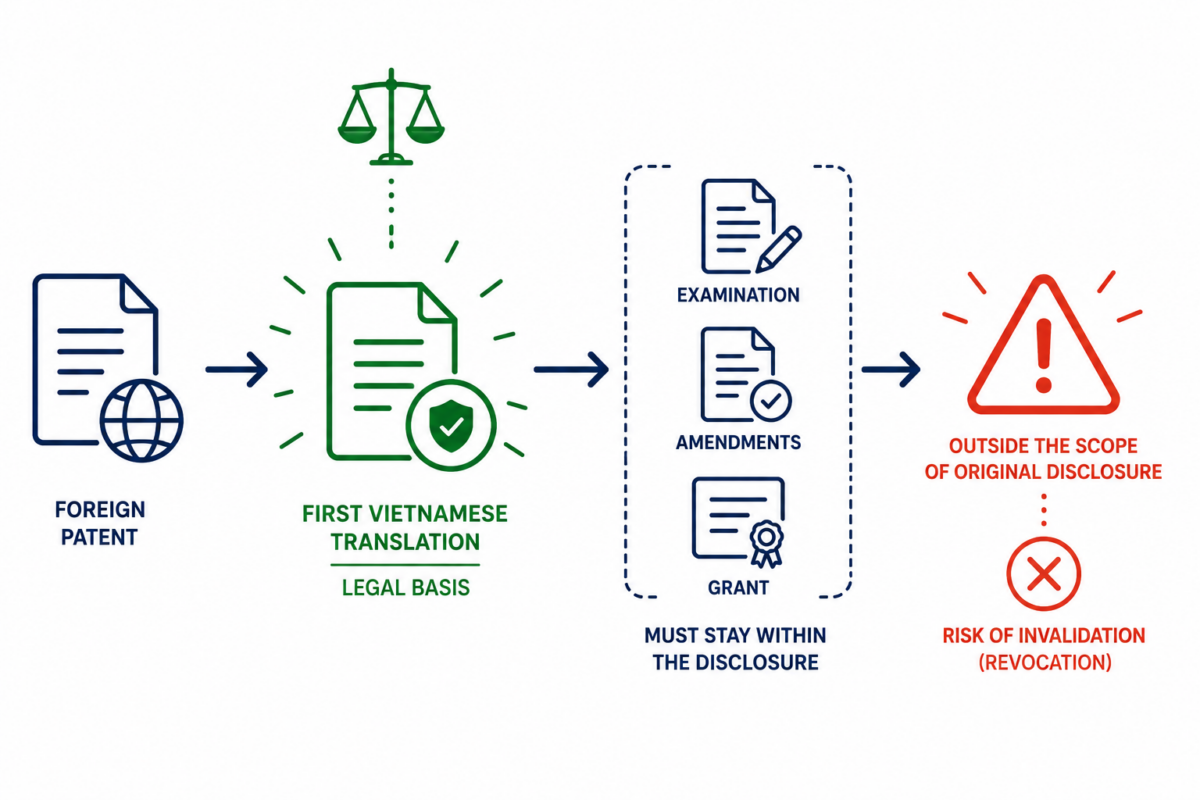
Together, these two provisions form a legal constraint that runs through the entire life cycle of a patent application. From the moment of filing, throughout examination, and even after the protection title is granted, the scope of protection can only be established within the limits of what was originally disclosed in the application as filed. It cannot later be broadened through amendments or supplements.
This has a very important consequence for patent translation. If the first translation omits, mistranslates, or unintentionally changes the meaning of a technical feature or a limiting element in the claims, any later correction will only be accepted if it does not introduce content beyond what was originally disclosed. If the correction is deemed to broaden the scope of protection or to change the essential nature of the subject matter stated in the application, it will not be accepted, even if the original error came from a translation mistake.
Conversely, if a protection title is granted based on a translation that broadens the scope of protection beyond what was actually disclosed in the original application, this can become grounds for a third party to request invalidation of the protection title under Article 96 of the Law on Intellectual Property. In other words, a translation error does not only affect the examination process. It can also threaten the legal validity of the protection title even after the right has already been established.
| The first patent translation filed is not simply a translation prepared to meet a filing formality. It is the legal document that the competent authority relies on to examine and process the patent application in Vietnam. Even a small discrepancy, such as omitting a limiting feature, choosing a term that does not accurately convey the intended legal meaning, or inaccurately expressing the scope of protection, can narrow the scope of protection or create a risk that the protection title will later be invalidated. |
II. Common Errors When AI Tools Translate Patent Applications
Artificial intelligence models, particularly large language models, have made significant progress in machine translation and are increasingly used in translation work. However, for patent translation specifically, current AI systems still cannot fully meet the requirements for legal accuracy, terminology consistency, and the drafting conventions of this field. In many cases, a translation may be linguistically correct yet still fail to meet the requirements of a patent document, because it does not fully reflect the legal nature of the content, does not follow presentation conventions, or does not maintain consistent terminology throughout the document. These shortcomings can affect the quality of the translation, the examination process, and even the scope of protection of the invention.
The errors AI tools commonly make when translating patent applications into Vietnamese are analyzed below.
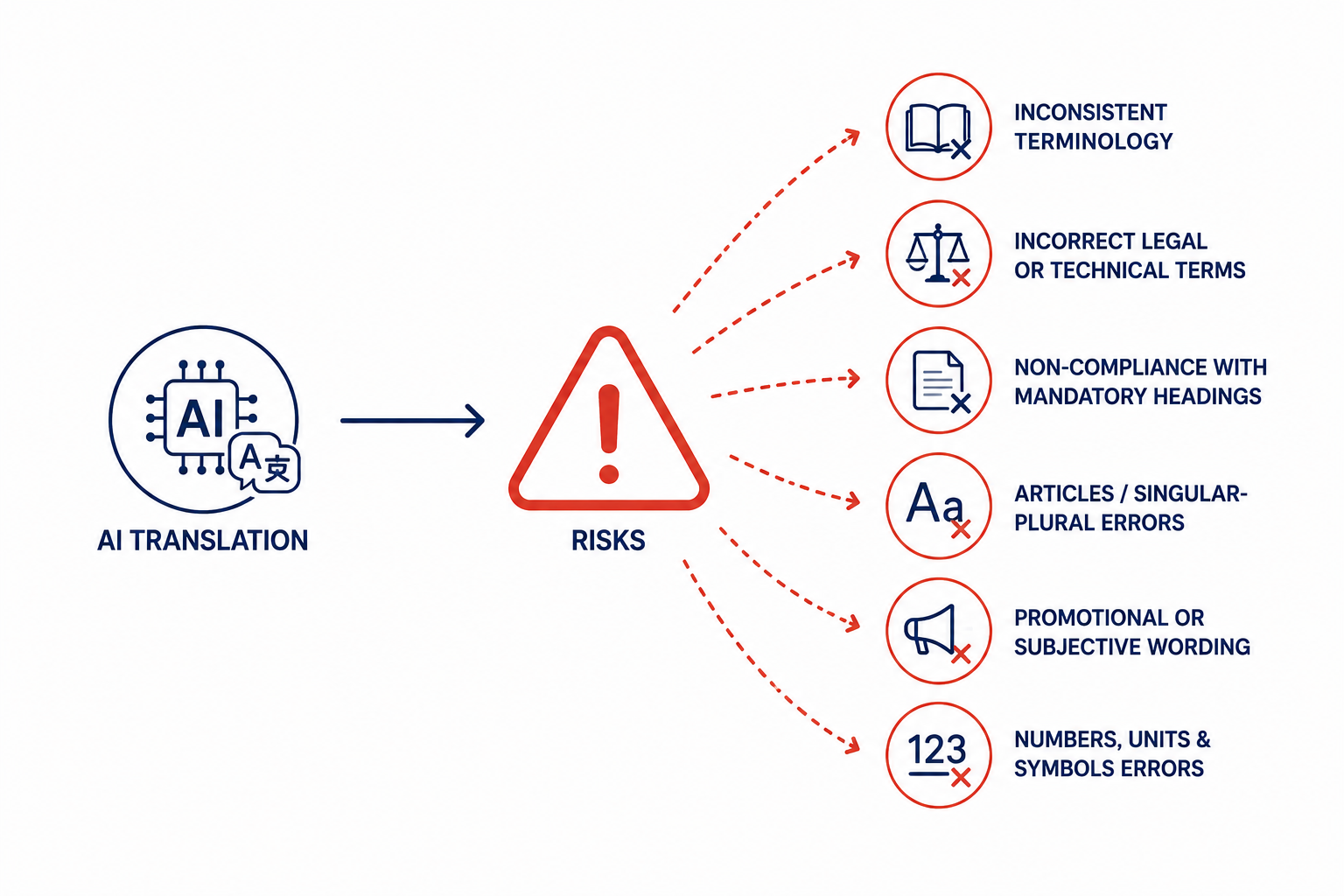
1. Inconsistent terminology throughout the document
AI models are trained to produce natural-sounding text, and avoiding word repetition is generally treated as a strength that improves fluency. However, this same trait becomes a significant weakness when translating patent applications. In the patent field, terminological consistency must be prioritized throughout the entire specification.
Each technical element should be identified by only one term, and that term must be used consistently throughout the document, from the title of the invention, to the abstract, the detailed description, the claims, and the drawing reference labels. Examiners and third parties rely on this terminological consistency to determine the relationships between technical features and the scope of protection. This requirement has a direct legal basis in Point đ, Clause 1, and Point b, Clause 8, Article 12 of Circular No. 10/2026/TT-BKHCN, which requires that terminology used in the application be consistent, and that terminology used in the claims be clear and consistent with the terminology used in the description.
For example, suppose the original document consistently uses the term “housing” to refer to the same component. An AI-generated translation might render this inconsistently as “vỏ”, “thân máy”, “hộp chứa”, and “vỏ bao” in different parts of the document. Taken sentence by sentence, each of these translations may be linguistically acceptable. However, when they appear together within the same patent specification, the reader, including the examiner, cannot tell whether these are simply different names for the same component or four separate technical components. This reduces the clarity of the specification and can lead the examiner to issue a notice requiring clarification or amendment.
As another example, suppose the original document consistently uses the term “fastener” to refer to the same connecting part. An AI tool might instead render it inconsistently as “chi tiết kẹp”, “bộ phận cố định”, “khóa cài”, and “phần tử liên kết” in different sections. Although each translation may be appropriate in certain contexts, using several different terms within a single application makes it difficult for the reader to determine whether the document is referring to one part or several different parts. When comparing the description against the claims, this inconsistency can reduce the clarity of the document and affect the examination process.
Inconsistent terminology is not a grammar or vocabulary error. It is an error of technical consistency. It is one of the most common errors made by AI translation systems when handling patent documents, and it is also an error that can directly affect the legal quality of the translation.
2. Inaccurate translation of specialized technical and legal terminology
One major limitation of AI when translating patent documents is contextual bias. Because AI models are trained primarily on general-purpose text, they tend to default to the most common everyday meaning of a word rather than its specific technical or legal meaning.
This risk is especially serious for two categories of terms.
Legal terms of art
AI often struggles to translate legal terms or terms that have already been standardized in the intellectual property field. Because it tends to prioritize common usage or general linguistic context, AI frequently produces a translation that is lexically correct but does not fit established legal practice or patent drafting conventions in Vietnam.
| Example | Person skilled in the art / Person having ordinary skill in the art /…. |
| Typical AI suggestion | “Người có kinh nghiệm”, “Người có tay nghề”, “Người thành thạo trong lĩnh vực” |
| Appropriate translation | “Người có hiểu biết trung bình trong lĩnh vực kỹ thuật” |
| Example | …between 5% and 11% of the moiety… |
| Typical AI suggestion | …giữa 5% và 11% của … |
| Appropriate translation | …nằm trong khoảng từ 5% đến 11% của … |
These examples show that AI tends to favor a literal linguistic equivalence, or to stay close to the phrasing of the source text, rather than using the terminology and expression conventions already standardized in Vietnamese patent translation practice.
Terms with different meanings across technical fields
A single English word can carry an entirely different meaning depending on the technical field, such as mechanical engineering, information technology, chemistry and pharmaceuticals, or biology. If AI fails to correctly identify the overall context of the invention, or if the translator lacks sufficiently deep subject-matter expertise, the resulting translation can easily be dictionary-correct while technically wrong.
The table below illustrates several terms whose meaning changes entirely depending on the specific technical field:
| Original Terms | Mechanical / Materials / Automation | IT / Electronics / Telecom | Chemistry / Pharma / Medicine | General Usage / Other Fields |
| Housing | Vỏ máy, hộp chứa, thân máy | Hộp ổ cứng, vỏ thiết bị | Nhà ở, bất động sản | |
| Terminal | Đầu nối, đầu kẹp (dây điện) | Thiết bị đầu cuối | Giai đoạn cuối (bệnh lý) | Bến xe, nhà ga, cảng |
| Substrate | Đế, giá đỡ, chất nền (vật liệu) | Lớp nền mạch in (PCB) | Cơ chất (phản ứng enzym) | Lớp đất nền |
| Medium | Môi trường (truyền nhiệt/lực) | Môi trường truyền dữ liệu | Môi trường nuôi cấy (sinh học) | Trung bình, vừa vặn |
| Vehicle | Tá dược, chất dẫn (bào chế) | Phương tiện giao thông, xe | ||
| Expression | Sự biểu hiện (dịch mã gen) | Biểu thức (Toán) / Biểu cảm | ||
| Culture | Sự nuôi cấy, môi trường vi sinh | Văn hóa (Xã hội học) | ||
| Lead | Dây dẫn (mạch điện) | Hợp chất dẫn đường (phát minh thuốc) | Kim loại chì / Dẫn dắt | |
| Carrier | Bệ đỡ, giá mang | Sóng mang (viễn thông) | Chất mang, vật chủ (sinh học) | Người vận chuyển, nhà mạng |
| Drive | Bộ truyền động, trục dẫn động | Ổ đĩa (lưu trữ) | Lái xe / Chiến dịch | |
| Valve | Van (thủy lực, khí nén) | Van tim (Giải phẫu) | Đèn điện tử chân không |
3. Non-compliance with mandatory section headings in the specification
Unlike ordinary technical documents, a patent specification filed in Vietnam must follow a set of mandatory section headings required by intellectual property law and established examination practice. These headings are standardized and must be used consistently. They should never be translated literally from the source document.
AI, however, tends to treat headings as ordinary text and translates them word for word, without recognizing that they are standardized administrative terms. Moreover, the same section may appear under several different headings in foreign patent documents, yet all of them must be mapped to the same standard heading when localized into Vietnamese.
| Standard Vietnamese patent heading | Common source-document equivalents |
| Tên sáng chế | Title of the Invention Title |
| Lĩnh vực kỹ thuật được đề cập | Field Technical Field Field of the Invention Field of the Disclosure |
| Tình trạng kỹ thuật của sáng chế | Background Background of the Invention Background Art Prior Art |
| Bản chất kỹ thuật của sáng chế | Summary Summary of the Invention Object of the Invention Brief Description |
| Mô tả vắn tắt các hình vẽ | Brief Description of the Drawings Drawings of the Invention |
| Mô tả chi tiết sáng chế | Detailed Description Detailed Description of Preferred Embodiments Description of the Invention |
| Ví dụ thực hiện sáng chế | Examples Examples of the Invention |
| Những lợi ích (hiệu quả) có thể đạt được | Advantages Advantageous Effects Effects of the Invention Benefits |
| Yêu cầu bảo hộ | Claims What is claimed We claim |
| Tóm tắt | Abstract Abstract of the Invention Abstract of the Disclosure |
Because AI does not recognize these standards, it can generate several different translations for the same heading. For example, it might translate “Technical Field” as “Lĩnh vực kỹ thuật”, “Field of the Invention” as “Lĩnh vực của sáng chế”, or “Background Art” as “Nghệ thuật nền”, instead of using the single standardized heading required. The consequence of this error does not change the technical content of the invention, but it can affect the formality examination. An application using non-standard headings may be required to be amended or supplemented, which lengthens the processing time and increases costs for the applicant.
4. Incorrect handling of singular/plural forms and articles
Unlike English, Vietnamese has no article system (a/an/the) and does not require a grammatical distinction between singular and plural. This makes AI prone to mishandling these grammatical markers in patent applications.
The English articles “a” and “an” serve a purely grammatical function. They do not limit the scope of the claimed subject matter, and under standard Vietnamese patent drafting practice they should be omitted in translation. However, because AI tends to translate word for word, many AI tools still render them with explicit counting phrases in Vietnamese, producing a translation that is linguistically accurate but inconsistent with patent drafting style and practice.
| Example | A device for… |
| Typical AI suggestion | Một loại thiết bị để… |
| Appropriate translation | Thiết bị để… |
| Example | An apparatus and method for… |
| Typical AI suggestion | Một dạng thiết bị và phương pháp để… |
| Appropriate translation | Thiết bị và phương pháp để… |
5. Literal translation of promotional, comparative, or evaluative language
Many original patent specifications use evaluative or emphatic language such as “excellent”, “superior”, “revolutionary“, “best” or “highly efficient“, etc. However, under established Vietnamese patent drafting and translation practice, the specification should be written in an objective, neutral style that focuses on the technical nature of the solution, rather than promotional language or claims of superiority.
AI-generated translations tend to stay close to the source text and preserve these evaluative adjectives when translating into Vietnamese. Although not incorrect in meaning, this approach is inconsistent with the objective and neutral style expected of a patent document.
| Example | The present invention provides a revolutionary and highly efficient solution. |
| Typical AI suggestion | “Sáng chế hiện tại cung cấp một giải pháp mang tính cách mạng và có hiệu quả vượt trội.” |
| Appropriate translation | “Sáng chế đề xuất giải pháp nhằm nâng cao hiệu quả…” |
This is not simply a matter of style. Absolute or promotional terms such as “best” or “revolutionary” may be regarded as lacking objective basis, or may require substantiation, when used to assert an advantage of the invention. For this reason, when translating into Vietnamese, such expressions are typically removed or converted into neutral language that describes only the technical nature of the solution. This requirement is also consistent with Point a and Point d, Clause 7, Article 12 of Circular No. 10/2026/TT-BKHCN, which prohibits the use of promotional or advertising language in the title of the invention and in the statement of the invention’s purpose and objectives.
6. Incorrect or inconsistent localization of figures, units of measurement, and symbols
This category of error does not stem from mistranslating words, but from AI’s inaccurate or inconsistent handling of non-linguistic elements such as numerical figures, units of measurement, technical symbols, chemical formulas, and reference numerals. The main cause is that Vietnamese presentation conventions differ in several respects from those of the source language, while AI tends to preserve the original formatting or apply localization rules incorrectly. A Vietnamese-language patent document must follow consistent presentation rules for these elements. This requirement has a direct legal basis in Point đ, Clause 1, Article 12 of Circular No. 10/2026/TT-BKHCN, which requires that symbols, units of measurement, electronic fonts, and spelling conventions used in the application follow Vietnamese national standards.
For example, AI may preserve the English number format, such as “10,000,000” instead of converting it to the Vietnamese convention, “10.000.000“. For chemical formulas, AI also often fails to follow standard presentation practice; for instance, “2M HCl” should be standardized as “HCl 2M” and “20% HCl” should be standardized as “HCl 20%“.
This is one of the categories of error that current AI systems still handle poorly, because they do not recognize and correctly apply the technical presentation conventions used in patent documents. For this reason, the translation still needs to be reviewed and standardized by a qualified professional to ensure accuracy, consistency, and compliance with presentation standards before filing.
III. Conclusion
What these errors have in common is that they do not stem from ordinary mistranslation, but from AI’s inability to fully recognize and comply with the specific legal, procedural, and drafting conventions of Vietnam’s patent system.
AI can effectively assist in producing an initial translation, but tasks such as standardizing the title of the invention, unifying terminology, refining the claims, checking document structure, and assessing whether the scope of protection is properly supported still need to be carried out by an intellectual property professional before filing.
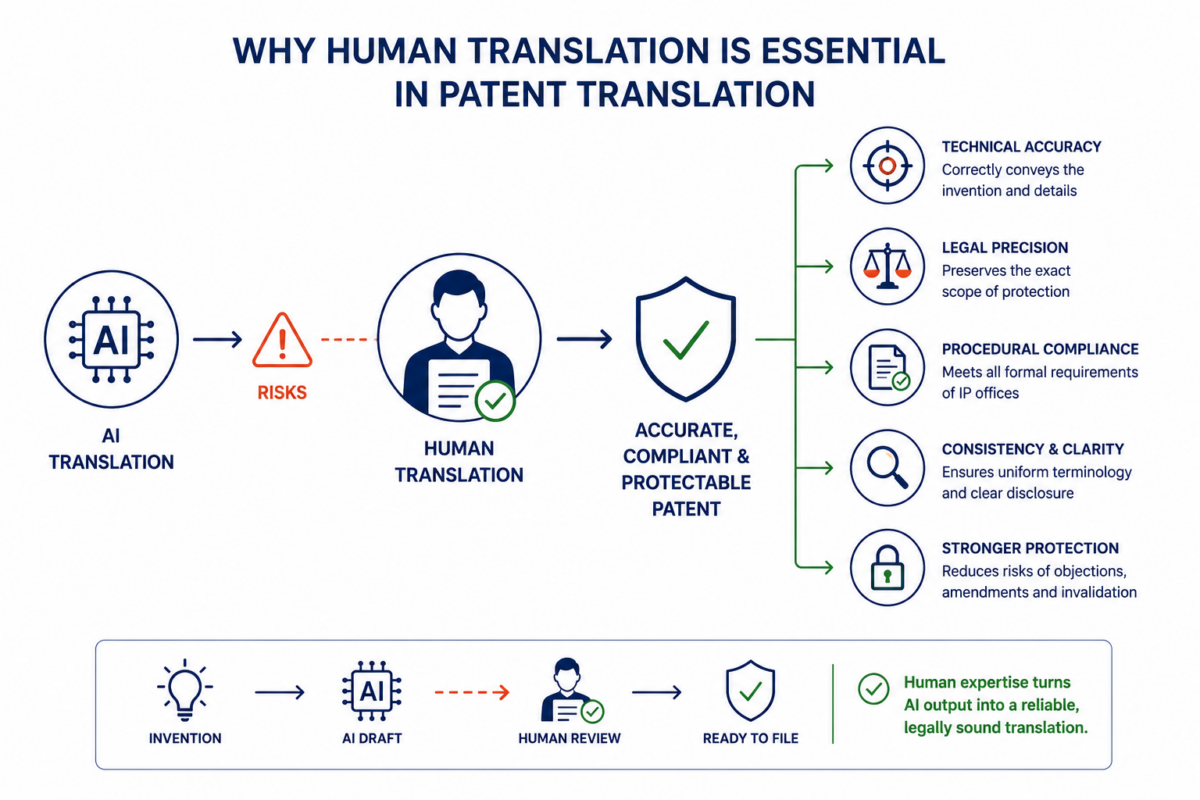
This is especially important because the translation filed on the initial filing date is the basis for determining the disclosed content of the application, and it limits what amendments or supplements can later be made, under Clause 1 and Point b, Clause 2, Article 28 of Circular No. 10/2026/TT-BKHCN, as well as Point đ, Clause 2, Article 96 of the Law on Intellectual Property. Reviewing the translation before filing is therefore the single most important risk-control step for protecting the scope of the invention.
| Because the first translation filed sets a fixed boundary for the entire scope of protection going forward (under Clause 1 and Point b, Clause 2, Article 28 of Circular No. 10/2026/TT-BKHCN, and Point đ, Clause 2, Article 96 of the Law on Intellectual Property), human review of that very first translation, rather than review at later amendment stages, is the most critical risk-control point in the entire patent protection process in Vietnam. |
References
1. Law on Intellectual Property No. 50/2005/QH11 dated November 29, 2005, of the National Assembly, as amended and supplemented by Law No. 36/2009/QH12, Law No. 42/2019/QH14, Law No. 07/2022/QH15, and Law No. 131/2025/QH15 (Consolidated Document No. 155/VBHN-VPQH dated September 9, 2025 of the Office of the National Assembly), Article 96.
2. Decree No. 65/2023/ND-CP dated August 23, 2023, of the Government, detailing a number of articles and measures for implementing the Law on Intellectual Property regarding industrial property, protection of industrial property rights, rights to plant varieties, and state management of intellectual property, as amended and supplemented by Decree No. 15/2026/ND-CP, Decree No. 33/2026/ND-CP, and Decree No. 100/2026/ND-CP.
3. Circular No. 10/2026/TT-BKHCN dated March 31, 2026, of the Ministry of Science and Technology, detailing a number of articles and measures for implementing the Law on Intellectual Property and Decree No. 65/2023/ND-CP (replacing the now-superseded Circular No. 23/2023/TT-BKHCN), Articles 12 and 28.





Need Legal Advice on Intellectual Property?
Our experienced IP lawyers provide comprehensive services: patent and trademark registration, industrial design, copyright, dispute resolution...
Get Free Consultation