


The “Priority Date” is a core concept in international and national Intellectual Property (IP) Law, particularly crucial for the protection of inventions. It serves as a vital timeline milestone that determines the inventor’s legal rights on a global scale.
1. What is the Patent Priority Date?
The Priority Date of a patent application is the date on which the first valid application for patent protection was filed with a competent national authority, typically the national IP Office. In the international context, this concept is primarily governed by the Paris Convention for the Protection of Industrial Property [1].
Under this Convention, an applicant who files a patent application in one member country is granted a specific period (usually 12 months) to file a subsequent application for the same invention in other member countries.
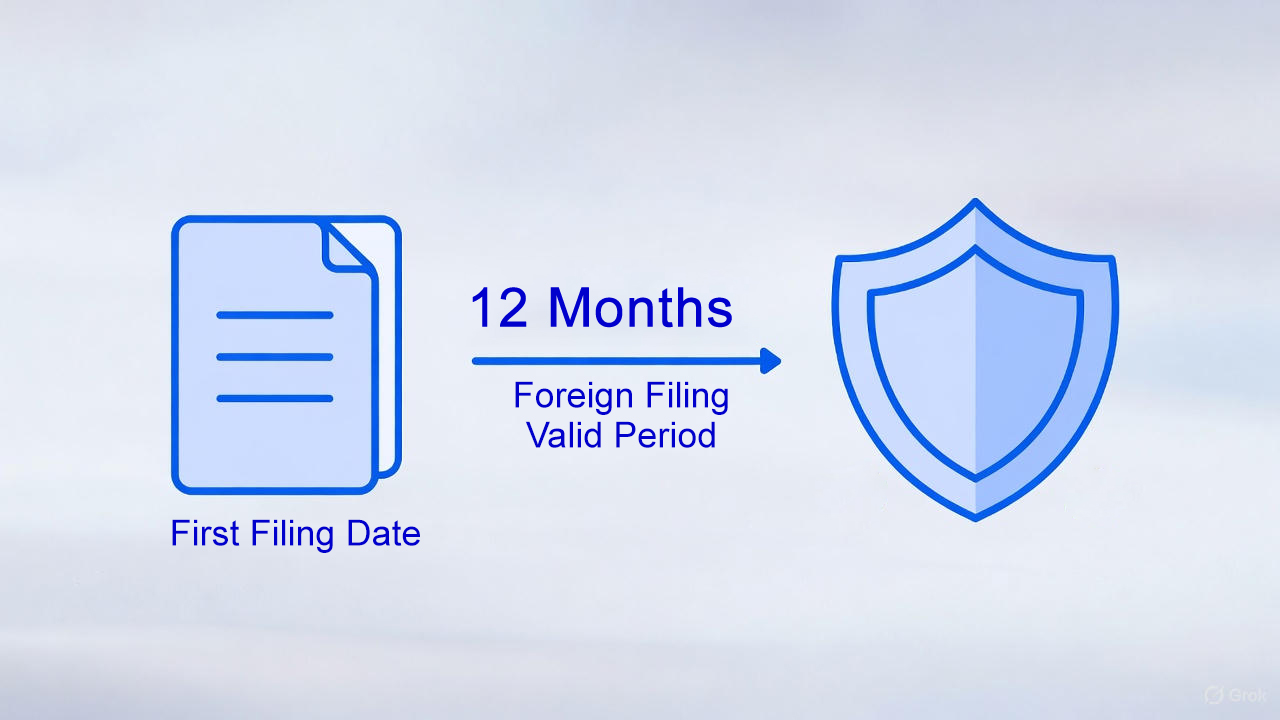
- If the subsequent applications are filed in other countries within this 12-month period, the filing date of those subsequent applications will be deemed the Priority Date of the initial application.
- Legally speaking, the subsequent applications are treated as if they were filed on that original Priority Date.
2. Why is the Priority Date the Most Important?
The Priority Date is considered the most important because it establishes an indispensable legal advantage for the inventor, based on the First-to-File Principle.
Determining Novelty and Inventive Step
This is its most crucial role. A prerequisite for an invention to be patentable is that it must possess novelty (not publicly disclosed) and an inventive step (not obvious to a person skilled in the art) at the time of filing [2].
- The Priority Date is the sole reference point used by the patent granting authority to assess the invention’s novelty and inventive step. Any public disclosure of the invention (whether by the inventor or by others) that occurs after the Priority Date will be disregarded during the examination.
- Without the Priority Date, any self-disclosure by the inventor before filing in a second country could destroy the novelty of the invention in that country.
Resolving Conflicting Applications
In cases where multiple applications are filed for the same or equivalent invention:
- The patent will be granted to the valid application with the earliest Priority Date or the earliest filing date (if no Priority Date is claimed) [3].
International Protection Extension
The Priority Date provides a critical 12-month “window” for the inventor to:
- Assess market potential in other countries without worrying about losing their rights due to public disclosure of the invention.
- Prepare the necessary filing documents, translations, and financial resources for expanding protection abroad, ensuring that the protection rights relate back to the original filing date.
3. Historical Origin of the Right of Priority
The principle of the Priority Date and the Right of Priority stems from the inception of international intellectual property law, specifically the Paris Convention for the Protection of Industrial Property:
Precedent: Lack of International Protection
Before 1883, patent protection was only effective within the national borders of the filing country. This created a significant problem:
- When an inventor filed an application in Country A, the invention was often disclosed.
- If the inventor then wanted to file in Country B, the invention had already lost its novelty due to its publication in Country A, preventing them from obtaining a patent in Country B. This forced inventors to file simultaneously in many countries, which was costly and impractical.
The Birth of the Paris Convention (1883)
- The Paris Convention was signed in Paris, France, in 1883, becoming the first multilateral international treaty on IP.
- Article 4 of this Convention officially established the “Right of Priority”. This right grants citizens of member countries, after making a first filing in one member country, a 12-month period for patents (and 6 months for trademarks and industrial designs) to file in other member countries while retaining the Priority Date of the initial application [1].
Thus, the priority date of an invention is not merely an administrative formality but the most critical legal safeguard within the international IP system. It grants inventors a unique advantage that cannot be purchased: the ability to secure retroactive protection from the moment the first application is filed.
Effectively leveraging the 12-month priority period under the Paris Convention constitutes a smart protection strategy, enabling businesses and inventors to: minimize the risk of losing novelty due to early disclosure, avoid being pre-empted by competing filings in other countries, and optimize market expansion planning and registration costs.
In short, for anyone involved in innovation, the priority date is the starting point of the entire patent protection journey. Understanding and strictly applying this principle ensures that your invention is not only recognized domestically but also supported by a solid legal foundation to secure and expand your rights on a global scale.
References
[1] World Intellectual Property Organization (WIPO). The Paris Convention for the Protection of Industrial Property, signed in Paris on March 20, 1883, last amended on October 02, 1979. (Article 4: Right of Priority).[2] World Intellectual Property Organization (WIPO). The Patent Cooperation Treaty (PCT), signed in Washington on June 19, 1970, as amended and supplemented.
[3] The National Assembly of the Socialist Republic of Vietnam. Law on Intellectual Property of Vietnam No. 50/2005/QH11, amended and supplemented by Law No. 36/2009/QH12, Law No. 42/2019/QH14, and Law No. 07/2022/QH15. (Article 58: General conditions for patent protection; Article 90: Principle of Priority).







Need Legal Advice on Intellectual Property?
Our experienced IP lawyers provide comprehensive services: patent and trademark registration, industrial design, copyright, dispute resolution...
Get Free Consultation