


1. Criteria for Assessing “Likelihood of Confusion”
Protecting a trademark is a strategic step for businesses to build competitive advantage. However, the most common reason for refusal at the National Office of Intellectual Property of Vietnam (IP Vietnam) is the “Likelihood of Confusion”.

Numerous trademark applications have been rejected for being identical or similar to the extent of causing confusion with previously registered marks. Importantly, many such cases could be avoided if the applicant clearly understands the assessment criteria under the Vietnamese Intellectual Property Law (IP Law) and conducts thorough searches.
The following aspects will be analyzed and presented:
- The legal basis for refusal due to confusion.
- The core criteria under the IP Law applied to assess similarity.
- Illustrative examples and detailed analysis.
- Strategies to increase the likelihood of acceptance when filing in Vietnam.
2. Legal Basis: How is “Likelihood of Confusion” Understood?
According to Article 74.2 of the Vietnamese IP Law, a trademark is considered non-distinguishable if it is identical or similar to the extent of causing confusion with a trademark that has been registered/is being protected for identical or similar goods or services. The concept of “Causing Confusion” does not only include complete identity, but also refers to:
- Confusion about the commercial origin (consumers believe both products belong to the same owner).
- Confusion about the relationship between the two businesses (for example: one is a subsidiary of the other).
- Or causing consumers to believe that the product originates from the same business entity.
This is the basis for many trademarks that are only vaguely similar, similar in overall impression, or phonetically similar to be rejected even if they are not 100% identical.
3. Criteria for Assessing “Likelihood of Confusion”
When evaluating whether a sign is “similar to the extent of causing confusion”, the IP Vietnam applies the principle of overall assessment, based on multiple factors according to Article 74 of the IP Law and the guidance in Decree 65/2023/ND-CP. The criteria below are the most important factors commonly used during the examination process.
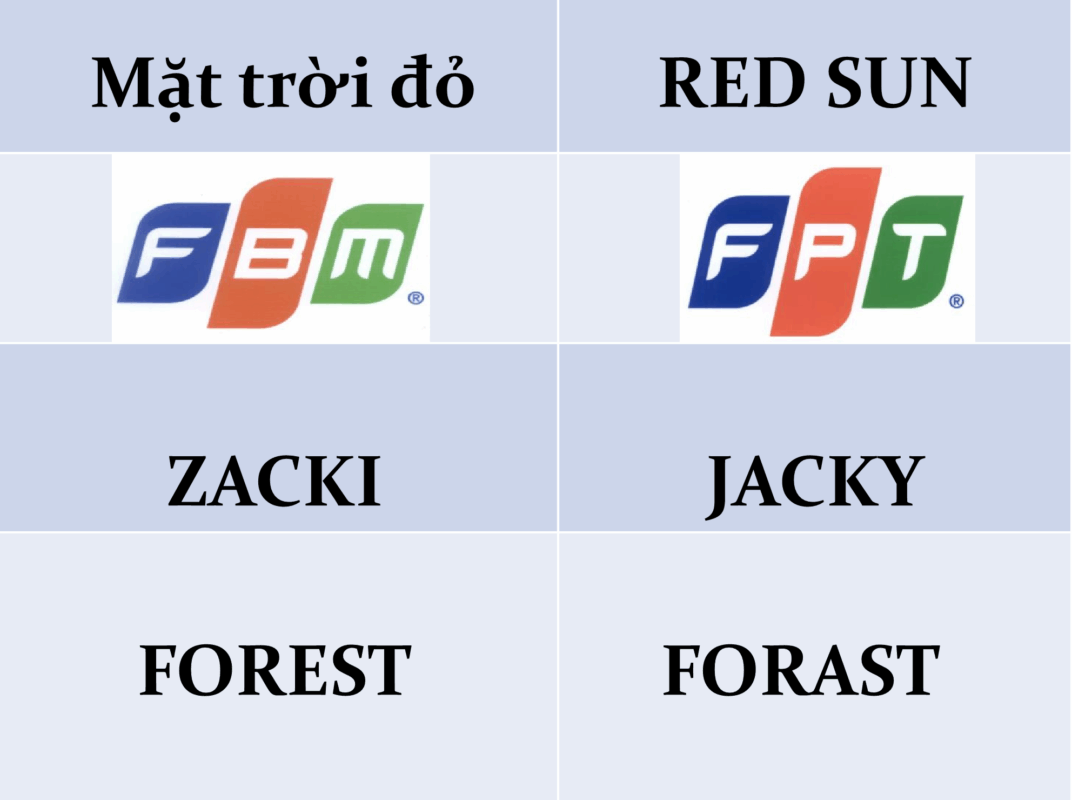
Table of Criteria and Assessment Content
| Criteria | Assessment Content | Illustrative Example |
| Structure & Component (Visual Appearance) | Assessment of the overall structure of the sign: number of characters, prefix – suffix, layout, and prominent elements that create distinctiveness. | Signs that share a strong prefix like “VITA–” in “VITACO” and “VITACOOL” may be considered structurally similar. |
| Pronunciation (Phonetic Similarity) | Even if the spelling is different, if the reading, syllables, or rhythm are similar, it may still be considered confusing. | “LAKA” and “LACCA”; “MEKO” and “MECO”. In Vietnam, short signs are often easily assessed as phonetically similar. |
| Meaning/Content (Conceptual Similarity) | Comparison of the meaning or conceptual impression conveyed by the sign. Synonymous or translated signs may lead to confusion. | “SUNRISE” and “BÌNH MINH” convey the same concept. Minor variations like “KING” and “KINGS” may also be considered as not creating significant difference. |
| Visual Element (Visual Image) | Applied to figurative marks or combined marks. Assessment of shape, identifying details, layout, proportion, and color (if protection is requested). | Two figurative marks with similar overall layout and form may be considered similar despite minor detail differences. |
| Distinctiveness of Components | Identifying the strong and weak parts of the sign. Descriptive components, those indicating origin, quantity, or quality, are often considered weak. If the strong part is identical/similar to the prior sign, the risk of refusal is high. | Common weak words: “milk”, “coffee”, “super”, “plus”, “premium”, or geographical names like “Saigon” in certain industries. |
| Similarity of Goods/Services | Assessment of the relationship between goods/services based on nature, purpose of use, distribution channels, and consumer groups. Being in a different Nice classification group does not mean they are unrelated. | Group 30 (coffee) and Group 43 (coffee shop services) are often considered similar or closely related. |
| Reputation of the Prior Mark | For well-known marks, the scope of protection is extended. Just the association or likelihood of confusion regarding commercial origin is enough for refusal, even on non-similar goods/services. | Marks like APPLE, NIKE, SONY are protected more broadly, even when applied to non-overlapping product groups. |
4. Illustrative Cases of Potential Trademark Refusal
The examples below illustrate how the IP Vietnam applies the criteria above during the examination process.
| Examples | Filing Mark | Prior Registered Mark | Assessment | Recommendation |
| 1. Pronunciation | MEKO | MECO | Pronunciation is nearly identical. Both have 4 letters and are in the same electrical equipment sector. | Don’t just look at the letters—pronunciation is also very important for short words. |
| 2. Overlapping Distinctive Element | SUNRISE MILK | SUN RISE | The strongest element is “SUNRISE”/“SUN RISE”. The word “MILK” is merely descriptive and lacks distinctiveness. | You cannot use a descriptive word to create a difference. |
| 3. Association with Well-known Mark | Apple shape (different style) | APPLE logo (well-known) | The “apple” element is highly characteristic in the electronics industry. The image, although different, creates an immediate association. | Avoid using a symbol “closely associated” with a well-known brand in the same sector. |
| 4. Related Goods/Services | KING BEER (Group 32) | KING COFFEE (Group 30) | The distinctive element “KING” overlaps. Beer and Coffee are considered to be in the same fast-moving consumer goods/beverage sector with similar distribution channels. | Generic names like KING, STAR are easily duplicated. Classification group is only one factor, not a guarantee of safety. |
| 5. Reversed Word Order | VIETPHARMA | PHARMA VIET | Both contain the components “VIET” and “PHARMA”. Reversing the order does not create significant difference, especially in the sensitive pharmaceutical sector. | Do not use the formula: Country Name + Industry Name. |
5. Common Pitfalls that May Lead to Refusal
These are common issues applicants encounter, significantly increasing the risk of refusal:
- Overconfidence in the logo or color: Many businesses believe a complex, detailed logo will ensure non-overlap. In reality, the IP Vietnam assesses the mark by its overall impression, not just minor details or colors.
- Misconception that a different Nice Group is safe: Some believe a mark in a different group of goods/services will be easily accepted. However, if the nature of the product or service is still related, the mark may still be refused, for example, when both involve the manufacturing and retailing of a type of product.
- Creating a mark by adding weak suffixes: Elements like -CO, -GROUP, -VIET, -PLUS usually do not create significant distinctiveness, thus the mark remains at risk of refusal.
- Failing to conduct a search before filing: This is the most common reason for businesses wasting time and costs. A mark that is identical or similar to a registered mark can be refused immediately at the formal examination stage.
- Believing that a registered company name means the trademark will be accepted: Company names and trademarks are two independent legal categories. Registering the company name does not guarantee the trademark will be granted.
6. Risk Mitigation Strategies: How to Get Accepted?
| Strategy | Recommended Action |
| In-depth Search/Pre-filing Assessment | Conduct a search of word and figurative elements on the IP Vietnam database to assess the likelihood of identity/similarity before filing. |
| Avoid Descriptive Words or Place Names | Prioritize creative marks (fanciful marks) or words unrelated to the product to increase distinctiveness according to Article 74 of the IP Law. |
| Add Truly Unique Elements | Add creative components, compound words (portmanteau), or design a logo with high distinctiveness; avoid weak suffixes like GROUP, CO, VIET, PRO…. |
| Define a Reasonable Scope of Goods/Services | Only register core goods/services to reduce the risk of conflict with prior marks, and align with the business strategy. |
| Prepare Arguments for Examination Response | Upon receiving a Notice of Provisional Refusal, prepare professional arguments regarding the differences, relevant consumers, and distribution channels to persuade the IP Vietnam. |
7. Trademark Examination Trends in Vietnam
In recent years, the trademark examination process in Vietnam has seen changes toward tighter standards and alignment with international norms. Some prominent trends include:
- Increasingly Strict Examination Level: The rapidly increasing number of applications coupled with strong competition in many sectors leads the IP Vietnam to tend toward more careful review. Assessments of distinctiveness, likelihood of confusion, and scope of protection are conducted more cautiously than before.
- Approaching International Examination Standards: Vietnam is gradually applying examination principles similar to the USPTO, EUIPO, and JPO. In practice, the IP Vietnam reviews marks based on the overall first impression, the degree of similarity in form, pronunciation, and meaning, as well as the perception of consumers in the relevant sector. These factors clearly reflect the trend of legal integration and the improvement in the quality of trademark examination in Vietnam.
- Certain Sectors are Reviewed More Strictly in Practice: In examination practice, industries such as pharmaceuticals, health protection foods, medical devices, and fintech services are often assessed more cautiously because the risk of confusion can directly affect consumers’ health or finances. This leads to a higher requirement for distinctiveness and clarity of the sign.
Summary
The “Likelihood of Confusion” is the most common ground for refusal in trademark examination, but it can be entirely predicted and controlled. A strong trademark not only successfully passes the examination process but also provides durable protection for the business in the market. To enhance the likelihood of acceptance, applicants need to understand how the IP Vietnam assesses marks, conduct thorough searches before filing, and build a trademark with high distinctiveness from the initial design stage.






Need Legal Advice on Intellectual Property?
Our experienced IP lawyers provide comprehensive services: patent and trademark registration, industrial design, copyright, dispute resolution...
Get Free Consultation